Do you often get confused when using helping verbs like can, should, or have? You’re not alone! Many learners make the same common mistakes with auxiliary and modal verbs, which can change the meaning of a sentence completely.
In this post, I will look at seven common mistakes that English learners make and show you how to fix them easily. With simple explanations and real examples, you’ll learn to use these verbs correctly and sound more natural in English.
1. Using Do Instead of Be in the Present Continuous
Learners often confuse “do” and “be” when forming continuous tenses. Remember, “do” works for simple present questions, but “be” (am, is, are) must be used for actions happening right now or in progress.
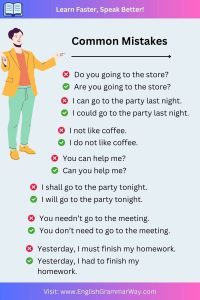
- Mistake: Do you going to the store?
- Correct Usage: Are you going to the store?
Explanation: The verb “do” is used for simple present questions, while “be” is needed for continuous tenses. To form the present continuous tense, always use the correct form of “be” (am, is, are) + verb-ing.
More Examples:
- Mistake: The project did completed on time.
Correct Usage: The project was completed on time. - Mistake: I do like pizza every day.
Correct Usage: I like pizza every day. - Mistake: She not understand the question.
Correct Usage: She does not understand the question. - Mistake: Do you happy with your job?
Correct Usage: Are you happy with your job? - Mistake: I will do a mistake.
Correct Usage: I will make a mistake.
2. Incorrect Use of Can and Could
It explains the mistake (using can for past events), provides the correct usage (could for past, can for present/future), and gives multiple examples to help learners understand and avoid this common error.
- Mistake: I can go to the party last night.
- Correct Usage: I could go to the party last night.
Explanation: “Can” is used for present and future ability, while “could” is the past form of “can.” When referring to a past event, always use “could.”
More Examples:
- Mistake: When I was a child, I can swim very well.
Correct Usage: When I was a child, I could swim very well. - Mistake: I could speak three languages. (when referring to now)
Correct Usage: I can speak three languages. - Mistake: Can you pass me the salt, please? (In very formal situations)
Correct Usage: Could you pass me the salt, please? - Mistake: It could rain tomorrow. (when making a general weather prediction)
Correct Usage: It can rain tomorrow. - Mistake: If I were taller, I can play basketball professionally.
Correct Usage: If I were taller, I could play basketball professionally.
Verb Common Mistakes
3. Forgetting Do in Negative Sentences
It highlights the mistake of leaving out do/does in present simple negatives and explains the correct rule, showing examples of proper negative sentences to help learners avoid this common error.
- Mistake: I not like coffee.
- Correct Usage: I do not like coffee.
Explanation: In the present simple tense, negatives need “do/does not” before the main verb (except with “be”). Many learners forget to include “do” in negative statements.
More Examples:
- Mistake: Do you happy with your job?
Correct Usage: Are you happy with your job? - Mistake: I do like pizza every day.
Correct Usage: I like pizza every day.
(Exception: “do” can be used for emphasis: I do like pizza! but not in regular statements.)
4. Misplacing Modal Verbs in Questions
It explains the mistake of putting modal verbs after the subject instead of before and provides examples showing the correct inversion, helping learners form proper English questions.
- Mistake: You can help me?
- Correct Usage: Can you help me?
Explanation: In English, modal verbs (can, should, must) should come before the subject in questions. Always invert the order.
More Examples:
- Mistake: She do her homework every day.
Correct Usage: She does her homework every day. - Mistake: Where you went yesterday?
Correct Usage: Where did you go yesterday? - Mistake: The project did completed on time.
Correct Usage: The project was completed on time.
5. Using Must Instead of Have To for Past Obligation
It clarifies the mistake of using must for past events and shows that “had to” should be used for past obligations, with examples to help learners apply the rule correctly.
- Mistake: Yesterday, I must finish my homework.
- Correct Usage: Yesterday, I had to finish my homework.
Explanation: ‘Must’ expresses necessity in the present and future, while “had to” is used for past obligations.
More Examples:
Mistake: Last night, she must study for her exam.
Correct Usage: Last night, she had to study for her exam.Mistake: Yesterday, we must clean the house.
Correct Usage: Yesterday, we had to clean the house.Mistake: He must go to the doctor last week.
Correct Usage: He had to go to the doctor last week.Mistake: They must leave early for the meeting yesterday.
Correct Usage: They had to leave early for the meeting yesterday.Mistake: I must buy groceries after work yesterday.
Correct Usage: I had to buy groceries after work yesterday.
6. Confusing Shall and Will
It explains the mistake of using shall in casual conversation and shows that will is the preferred modern choice, while shall remains formal or legal. Examples clarify proper usage for everyday English.
- Mistake: I shall go to the party tonight. (In casual speech)
- Correct Usage: I will go to the party tonight.
Explanation: “Shall” is more formal and old-fashioned, often used in legal or formal writing. In everyday conversation, “will” is the preferred choice.
7. Overusing Needn’t Instead of Don’t Need To
It explains the mistake of using needn’t too often, highlighting that don’t need to is more natural in modern English, with examples showing the correct, everyday usage.
- Mistake: She needn’t worry about the test.
- Correct Usage: She don’t need to worry about the test.
- Mistake: They needn’t bring any food to the party.
- Correct Usage: They don’t need to bring any food to the party.
- Mistake: You needn’t finish the report today.
- Correct Usage: You don’t need to finish the report today.
- Mistake: He needn’t call the office again.
- Correct Usage: He doesn’t need to call the office again.
- Mistake: We needn’t attend the meeting if we’re busy.
- Correct Usage: We don’t need to attend the meeting if we’re busy.
Explanation: “Needn’t” is correct but very formal. In modern English, “don’t need to” is more common.
Read More: