I that.
You this.
When you read these lines, they feel broken and confusing. You can sense that something important is missing, but you may not immediately know what it is.
Now read this instead:
I did that.
You did this.
The meaning suddenly becomes clear.
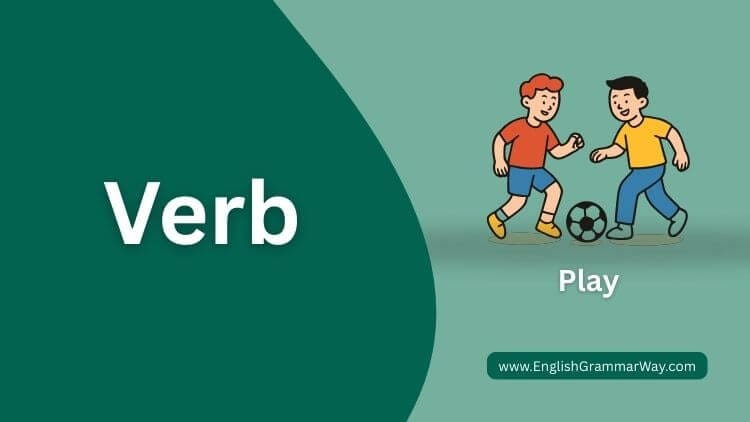
Those small words like do, did, is, are, and feel help us explain actions, situations, and experiences. These words are called verbs. Verbs allow us to talk about what we do every day, what happens around us, and how we feel inside.
Imagine a world where you cannot say I eat, she works, or they are happy. Communication would almost stop. That is why verbs are one of the most important parts of English grammar. In this section, you will clearly understand what a verb is and why it is essential in every sentence.
What is a Verb in English Grammar?
In English grammar, a verb is the word that tells us what the subject does, feels, or experiences. It plays a key role in a sentence because it shows action, emotion, or a state of being. Without a verb, a sentence cannot clearly explain what is happening.
A verb can describe:
Actions – Things we physically do, such as run, write, eat, or study.
Feelings – Emotions and thoughts, like love, feel, believe, or think.
States of being – Situations or conditions, such as is, are, was, or were.
Every complete sentence in English must include a verb. If a sentence has no verb, it sounds incomplete and confusing. For example, the sentence “She very happy” does not clearly express meaning. When we add a verb “She is very happy” the sentence becomes grammatically correct and easy to understand.
Verbs also change their form to show time, such as past, present, or future, and to agree with the subject. This flexibility helps us describe events accurately in daily conversation and writing. That is why verbs are often called the heart of English grammar.
Definition of a Verb
A verb is a word that explains what the subject of a sentence does, feels, or experiences. It can describe an action, such as eat or sing, an event like happen, or a state of being, such as exist or feel. Verbs are always connected to a subject and help tell what happens to a person, thing, or idea. They give clear information about actions, conditions, and experiences. Without verbs, sentences would not make sense because they would fail to explain what is actually happening. That is why verbs are essential for clear and meaningful communication in English.
According to the Oxford Learner’s Dictionaries, a verb is a word or group of words that expresses an action (e.g., eat), an event (e.g., happen), or a state (e.g., exist). It is a fundamental part of speech that acts as the core of a predicate in a sentence.
1 Regular vs. Irregular Verbs
In English, verbs are divided into regular and irregular verbs.
Regular verbs are the simple and predictable ones. To make their past tense or past participle, you usually just add “-ed” at the end (or “-d” if the verb already ends with an “e”). Easy, right?
Examples with “finish”:
- Sarah finished her work.
- Claude had finished his dinner when James called.
- Jock has finished writing in his journal.
- Tina will have finished her course by the end of next month.
On the other hand, irregular verbs don’t follow these rules. Their past forms are unique, so you just have to learn them.
Examples with “swim”:
- Andre swam in all five of the Great Lakes last summer.
- I had swum almost a mile when the island came into view.
- Melissa has swum every Saturday for the last three years.
- If he succeeds next week, Antonio will have swum the English Channel ten times!
In short, regular verbs are predictable, while irregular verbs are a bit tricky—but once you get the hang of them, using both becomes second nature.
2 Transitive and Intransitive Verbs
English verbs can be split into two main types: transitive and intransitive. The difference lies in whether the verb acts on something or not.
Transitive verbs need a direct object, which is the thing or person receiving the action. These verbs are basically “doing something to someone or something.”
Examples:
- Kelly asked a question.
- Toby bought groceries.
In these sentences, question and groceries are the objects being acted upon. Without them, the sentence would feel incomplete.
Intransitive verbs, on the other hand, don’t have a direct object. They express an action or state on their own. However, you can add extra information using adverbs or phrases to describe how, when, or where the action happens.
Examples:
- Kelly coughed.
- Kelly coughed loudly.
- Kelly coughed on me.
Some verbs are ditransitive, meaning they take two objects: one direct and one indirect. The indirect object usually shows who benefits from the action.
Example:
- Kelly reads me a book.
Here, a book is the direct object, and me is the indirect object.
Knowing whether a verb is transitive, intransitive, or ditransitive helps you write and speak English more accurately and naturally.
3 Stative and Dynamic Verbs
In English, verbs can be divided into dynamic (action) verbs and stative verbs. Understanding the difference helps you use verbs correctly in sentences.
Dynamic verbs describe actions or events that are temporary or specific. These verbs show something someone does, often something you can see or measure.
Examples of dynamic verbs:
- Amy kicks the ball.
- Lydia is running to school.
Dynamic verbs can be used in all tenses, including the progressive (continuous) tense, because they describe actions that can start and stop.
Stative verbs, on the other hand, describe a state of being, condition, or perception rather than an action. They often show feelings, thoughts, relationships, or general truths.
Examples of stative verbs:
- Karl believes in himself.
- This idea seems
- They belong to the same team.
Unlike dynamic verbs, stative verbs usually cannot be used in the continuous tense because the state they describe is considered permanent or general. For example:
- Karl is believing in himself. (incorrect)
- Karl believes in himself. (correct)
By knowing whether a verb is dynamic or stative, you can make your English sentences more accurate and natural.
4 Linking Verbs
A linking verb, also called a copular verb, doesn’t show an action. Instead, it connects the subject of a sentence to a word that describes or identifies it. This describing word is called a subject complement, usually a noun or an adjective.
To learn how linking verbs differ from action verbs, read Action Verbs vs Linking Verbs
Common linking verbs include: be, seem, become, feel, appear, look, and grow.
Examples of linking verbs in sentences:
- Fionn is proud of his achievement.
- The pillow feels soft and comfortable.
- She seems happy today.
- The weather became colder in the evening.
In all these examples, the verbs don’t show an action. They simply link the subject (Fionn, the pillow, she, the weather) to something that describes it (proud, soft and comfortable, happy, colder).
Some linking verbs can also act as action verbs, depending on the context. For example:
- Sofie feels the pillow carefully. (action)
- He looks at the painting for a long time. (action)
Knowing how linking verbs work helps you distinguish between states and actions, making your English sentences more accurate and natural.

5 Modal Verbs
Modal verbs are a special type of auxiliary verb that work together with a main verb to express things like ability, permission, possibility, necessity, or obligation. Unlike regular verbs, modal verbs do not change form.
The most common modal verbs are:
can, could, may, might, must, ought, shall, should, will, would.
Examples of modal verbs in sentences:
- I can read Arabic and Hebrew. (ability)
- Martin should speak a little louder. (advice)
- Talia ought to perform at the talent show. (obligation)
- You might enjoy this movie. (possibility)
In each case, the modal verb helps show the speaker’s attitude or intention rather than the action itself.
Using modal verbs correctly can make your English more polite, precise, and natural, whether you’re giving advice, asking permission, or talking about possibilities.
6 Auxiliary Verbs
Auxiliary verbs, also known as helping verbs, are used alongside a main verb to add meaning or show additional information about the action. They help express tense, mood, voice, and are also used to form negative sentences or questions.
The most common auxiliary verbs are be, do, and have. They are always used with another verb to complete the idea. Unlike modal verbs, auxiliaries change form depending on the subject and tense.
Examples of auxiliary verbs in sentences:
- I am waiting for the bus. (present continuous tense)
- Did you enjoy the meal? (question using “do”)
- The door was locked. (past tense, passive voice)
- Alicia has not spoken to me for a week. (present perfect negative)
Auxiliary verbs are essential for forming different tenses, asking questions, and making sentences negative. Using them correctly makes your English sound accurate, natural, and fluent.
7 Phrasal Verbs
A phrasal verb is a combination of two or more words, usually a verb plus an adverb or preposition, that together act as a single verb with a meaning often different from the original verb.
For example, the verb “kick” and the preposition “off” combine to form “kick off,” which means “to begin.”
Examples of phrasal verbs in sentences:
- I’m going to move out next month. (leave home)
- She gave up smoking last year. (quit)
- We need to look after the children. (take care of)
- The meeting ran over by 15 minutes. (last longer than planned)
Phrasal verbs are very common in English, especially in spoken language. Knowing them helps your English sound natural and fluent, as they often replace longer or more formal expressions.
8 Gerunds
A gerund is a verb form that acts like a noun in a sentence. It is created by adding “-ing” to the base verb. Even though it looks like a verb, a gerund behaves as a noun, so it can be the subject, object, or complement in a sentence.
Examples of gerunds in sentences:
- Eating fruits and vegetables is good for you. (subject)
- She enjoys reading before bed. (object)
- He is interested in learning (object of a preposition)
- Swimming in the ocean relaxes me. (subject)
Gerunds are very useful because they let you turn actions into ideas or things you can talk about. Once you get the hang of them, you’ll see them everywhere in both written and spoken English.
Frequently Asked Questions on Verbs in English Grammar
Q1. What is a verb?
A verb is one of the most important parts of speech in English. It helps us understand what the subject of a sentence is doing, feeling, or experiencing. Verbs are not limited to physical actions like run or write; they also express emotions, thoughts, and conditions such as love, think, or exist. Since verbs appear in different forms and types, they help complete the meaning of a sentence and make communication clear.
Q2. What is the definition of a verb?
A verb is a word or group of words that describes an action, an event, or a state of being. It works with a subject to explain what happens or what someone or something experiences. Verbs like sing, feel, and die give information about actions, situations, or conditions. Without verbs, sentences would not be able to express ideas properly or make sense.
Q3. What are the types of verbs?
Verbs can be grouped based on what they express. Some verbs show actions, while others describe feelings or experiences, and some indicate a state or condition. In English grammar, verbs are also classified into several types such as auxiliary (helping) verbs, modal verbs, phrasal verbs, and linking verbs, each serving a different grammatical purpose.
Q4. What are the different verb forms in English?
English verbs appear in multiple forms to express time, voice, and usage. These include the base form, third-person singular form, present participle, simple past, past participle, gerund, and infinitive forms. Verbs can also be used in active and passive voice. These different forms help us communicate clearly and accurately in both spoken and written English.
Other Interesting Articles
If you want to dive deeper into English grammar, don’t stop here! We have plenty of other articles covering nouns, pronouns, verbs, and all the other parts of speech.
Each article is packed with clear explanations, examples, and tips to help you understand and use English confidently. Whether you’re learning for school, work, or just for fun, these resources can make grammar easy and interesting.
Check out our other language articles and take your English to the next level!