The parts of speech are the building blocks of the English language. This Simple Guide to the Parts of Speech will help you understand how each part works.
Whether you’re a student or someone looking to improve your communication skills, mastering the parts of speech is essential. Here, we’ll explore the eight main parts of speech with examples to simplify the concept for you.
What are Parts of Speech?
Nouns are the backbone of the English language. They are the roles of words in a sentence. Knowing them helps you understand and write better and can make your communication clearer.
There are eight main parts of speech:
- Noun – Names a person, place, thing, or idea.
Example: Dog, city, happiness
Sentence: The dog is playing in the park. - Pronoun – Replaces a noun to avoid repetition.
Example: He, she, they
Sentence: She loves reading books. - Verb – Shows an action or state of being.
Example: Run, eat, is
Sentence: I run every morning. - Adjective – Describes a noun or pronoun.
Example: Happy, blue, tall
Sentence: The blue sky looks beautiful today. - Adverb – Describes a verb, adjective, or another adverb.
Example: Quickly, very, well
Sentence: She runs quickly to catch the bus. - Preposition – Shows the relationship between a noun (or pronoun) and another word.
Example: In, on, under, between
Sentence: The book is on the table. - Conjunction – Connects words, phrases, or clauses.
Example: And, but, or
Sentence: I like tea and - Interjection – Expresses strong emotion or sudden reaction.
Example: Wow! Ouch! Hurray!
Sentence: Wow! That’s an amazing view.
Summary:
The basic understanding of parts of speech is a stepping stone to good sentence formation, vocabulary expansion and effective communication. Every single word has its special task in a sentence; you will definitely learn English more easily once you get them.
Simple Guide to the Parts of Speech
Understanding the parts of speech is essential for mastering English grammar. In this guide, we’ll explore each part of nouns, verbs, adjectives, adverbs, pronouns, prepositions, conjunctions, and interjections and show you how they work together to form meaningful sentences. Whether you’re a beginner or looking to brush up on your skills, this guide provides everything you need to enhance your language proficiency.
1. Nouns
Nouns name people, places, things, or ideas. They form the subject or object of a sentence.
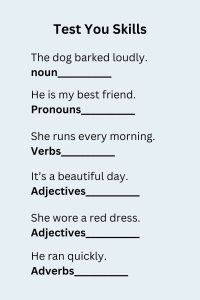
- Example: The dog barked loudly. (dog is a noun.)
- Example: She has a great idea. (idea is a noun.)
2. Pronouns
Pronouns replace nouns to avoid repetition.
- Example: He is my best friend. (He replaces a specific person’s name.)
- Example: They went to the park. (They replace multiple individuals.)

3. Verbs
Verbs express actions, occurrences, or states of being.
- Example: She runs every morning. (runs is an action verb.)
- Example: I am happy today. (Am is a state of being verb.)
4. Adjectives
Adjectives describe or modify nouns and pronouns, adding details about qualities or quantities.
- Example: It’s a beautiful day. (Beautiful describes the day.)
- Example: She wore a red dress. (red describes the dress.)
5. Adverbs
Adverbs modify verbs, adjectives, or other adverbs. They often tell how, when, where, or to what extent something happens.
- Example: He ran quickly. (quickly modifies the verb ran.)
- Example: The movie was very interesting. (very modifies the adjective interesting.)
6. Prepositions
Prepositions show relationships between nouns (or pronouns) and other parts of the sentence.
- Example: The book is on the table. (on shows the relationship between the book and the table.)
- Example: She walked through the park. (through shows movement.)
7. Conjunctions
Conjunctions connect words, phrases, or clauses.
- Example: I wanted to go, but I was too tired. (but connects two clauses.)
- Example: Bring your coat and scarf. (and connects two nouns.)
8. Interjections
Interjections are short exclamations that express emotions.
- Example: Wow! That’s amazing. (Wow! expresses surprise.)
- Example: Oops! I dropped my phone. (Oops! shows a mistake.)
Conclusion
Learning the parts of speech is the first foundation in your path to mastering English! Start by finding these categories in simple sentences and using them in your writing.
Your communication skills will get better over time. Well, as people say, good grammar is the root of all proper writing.
Read More: