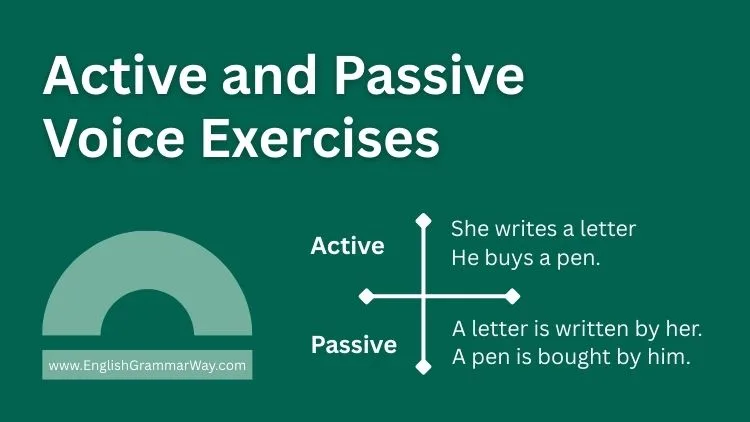
Active voice is one of the most important concepts in English grammar, especially for learners who want to write clearly and confidently. When you use active voice, your sentences become more direct, engaging, and easier to understand. That is why most teachers, editors, and professional writers strongly recommend using active voice whenever possible.
In simple terms, active voice shows who is doing the action. The subject of the sentence performs the verb’s action, making the message clear and natural. As a result, readers understand the meaning quickly without confusion or extra effort.
If you are learning English grammar from basic to advanced levels, understanding active voice will greatly improve your sentence structure. It also helps you avoid weak, unclear, or overly complicated sentences that often appear in passive constructions.
In this lesson, you will explore Active Voice Examples in Sentences, compare active and passive voice, practice exercises, and learn why active voice matters in real writing. For a deeper understanding, you may also read related lessons like What Is Voice in English? and Passive Voice Rules with Examples.
What Is Active Voice? (Simple Explanation)
Active voice is used when the subject of a sentence performs the action of the verb. This structure makes sentences direct, strong, and easy to follow. Most everyday conversations and professional writings naturally use active voice.
For example:
John painted the fence.
Here, John is the subject, painted is the verb, and the fence receives the action. Because the subject performs the action, this sentence is in active voice.
Now compare it with a passive sentence:
The fence was painted by John.
In this case, the subject (the fence) does not perform the action. Instead, the focus shifts away from the doer, making the sentence passive.
Active voice is preferred because it improves clarity, reduces wordiness, and strengthens communication. To read more about this topic, you can explore our detailed guide on Active and Passive Voice.
Easy Examples of the Active and Passive Voice
Understanding the difference becomes easier when you see examples side by side. Active voice emphasises the doer, while passive voice emphasises the action or result.
Active Voice: The teacher explains the lesson.
Passive Voice: The lesson is explained by the teacher.
Active Voice: She completed the assignment.
Passive Voice: The assignment was completed by her.
In active voice, sentences sound natural and confident. In contrast, passive voice often sounds formal or indirect.
Formal Definitions of Active Voice
In grammar terms, active voice is defined as a sentence structure where the subject acts upon the verb directly. The subject is responsible for the action described in the sentence.
From a writing perspective, active voice improves readability and engagement. Therefore, it is widely used in essays, blogs, emails, and storytelling. Passive voice, however, is mainly used in scientific, legal, or formal writing when the doer is unknown or unimportant.
Four Interactive Examples of Active Voice
- The cat chased the mouse.
(The subject cat performs the action.) - The chef prepared the meal.
(The chef is clearly doing the action.) - She writes articles every day.
(The sentence feels direct and natural.) - They solved the problem quickly.
(The focus stays on the doers.)
Each example shows how active voice keeps sentences clear and engaging.
Examples of Verbs in the Active Voice
Active voice verbs clearly show action. Some common verbs often used in active voice include write, make, build, teach, learn, explain, and create.
For example:
- He teaches English grammar.
- She writes blog posts regularly.
- They build strong sentences.
76 Active Voice Examples in Sentences for Writing
Below are natural and practical Active Voice Examples in Sentences that you can use in daily writing:
- She reads English books every night.
- The boy kicked the ball hard.
- We finished the project early.
- The teacher explained the rule clearly.
- He writes articles for his website.
- They cleaned the classroom together.
- I completed my homework on time.
- The manager approved the request.
- She answered all the questions confidently.
- The dog guarded the house.
- He opened the door slowly.
- The students practiced grammar exercises.
- She baked a chocolate cake.
- We watched an educational video.
- The author published a new book.
- He fixed the computer quickly.
- The baby cried loudly.
- She organized the meeting perfectly.
- They planted trees in the park.
- The driver stopped the car suddenly.
- I learned active voice rules today.
- She teaches grammar online.
- The sun melted the ice.
- He washed the dishes carefully.
- We completed the lesson successfully.
- She designed a beautiful website.
- The team won the match.
- He explained the topic simply.
- The chef cooked delicious food.
- She cleaned her room.
- They solved the puzzle together.
- The doctor treated the patient.
- I wrote a short paragraph.
- She painted the wall blue.
- He delivered the package safely.
- We discussed the problem openly.
- The teacher checked the notebooks.
- She sang a lovely song.
- They repaired the broken chair.
- He answered the phone immediately.
- The writer edited the article.
- She taught English grammar clearly.
- We completed all exercises.
- The child broke the glass.
- He arranged the books neatly.
- She closed the window gently.
- They organized a study group.
- I practiced active voice sentences.
- The librarian issued the book.
- She helped her friend.
- The bird built a nest.
- He solved the math problem.
- We followed the instructions carefully.
- She decorated the room beautifully.
- The teacher praised the student.
- He bought a new dictionary.
- They started the lesson early.
- I understood the grammar rule.
- She explained active voice examples.
- The player scored a goal.
- He learned English grammar quickly.
- We improved our writing skills.
- She completed the assignment alone.
- The team planned the project.
- He opened a grammar book.
- They prepared for the exam.
- I read the lesson carefully.
- She wrote clear sentences.
- The teacher guided the students.
- He practiced every day.
- We shared our ideas freely.
- She corrected her mistakes.
- The editor improved the article.
- He explained passive voice briefly.
- They learned active voice rules.
- I enjoy writing in active voice.
Active Voice Examples
- She teaches English grammar.
→ The subject she performs the action. - He writes blog posts.
→ The action is clear and direct. - They solved the issue.
→ The doer is clearly mentioned. - I completed the lesson.
→ The subject completes the action. - The teacher explained the rule.
→ Active subject improves clarity. - She cleaned the room.
→ Simple and direct structure. - We watched the video.
→ Natural sentence flow. - He fixed the problem.
→ Focus on the doer. - They finished the task.
→ Strong and confident tone. - She answered the question.
→ Clear responsibility shown.
Active and Passive Voice Exercises
These Active and Passive Voice Exercises help learners understand how to change passive sentences into active ones with confidence. By practising these exercises, you can clearly identify the subject, verb, and object in each sentence. As a result, your sentence structure becomes stronger, clearer, and more natural for both writing and speaking.
Exercise:
- The lesson was explained by the teacher.
- The book was written by the author.
- The room was cleaned by her.
- The homework was completed by the student.
- The match was won by the team.
- The cake was backed by my mother.
- The email was sent by him.
- The door was opened by the guard.
- The article was edited by the writer.
- The song was sung by her.
- The work was finished by them.
- The problem was solved by the engineer.
- The class was taught by the professor.
- The car was repaired by the mechanic.
- The speech was delivered by the leader.
- The lesson was learned by the students.
- The form was filled by her.
- The rules were explained by the teacher.
- The project was planned by the team.
- The book was read by me.
Answers
- The teacher explained the lesson.
- The author wrote the book.
- She cleaned the room.
- The student completed the homework.
- The team won the match.
- My mother baked the cake.
- He sent the email.
- The guard opened the door.
- The writer edited the article.
- She sang the song.
- They finished the work.
- The engineer solved the problem.
- The professor taught the class.
- The mechanic repaired the car.
- The leader delivered the speech.
- The students learned the lesson.
- She filled the form.
- The teacher explained the rules.
- The team planned the project.
- I read the book.
Active Voice Examples in Sentences FAQs
Q1. What are active voice examples in sentences?
Active voice examples in sentences show that the subject performs the action. For example, “She writes articles daily.” Here, the subject she does the action writes. This structure makes sentences clearer and more engaging for readers.
Q2. How do you identify active voice in a sentence?
To identify active voice, ask this simple question: Who is doing the action?
If the subject is clearly doing the action, the sentence is in active voice.
Example: “The teacher explains the rule.” The teacher performs the action.
Q3. Why are active voice examples important for better writing?
Active voice examples are important because they make writing clear, direct, and confident. They reduce unnecessary words and help readers understand ideas faster. That is why active voice is preferred in blogs, essays, emails, and everyday English writing.
Q4. What is the difference between active and passive voice, with examples?
- In active voice, the subject performs the action.
Example: “The student completed the homework.” - In passive voice, the action is done to the subject.
Example: “The homework was completed by the student.”
Active voice sounds more natural and strong, while passive voice sounds formal or indirect.
Q5. When should passive voice be used instead of active voice?
Passive voice can be used when the doer is unknown, unimportant, or obvious.
For example, “The road was repaired last night.”
However, in most cases, active voice is better for clear and effective communication.