
Writing clear sentences is essential for exams, and knowing Passive Voice to Active Voice can make a big difference. Many students get confused when subjects are unclear or when sentences are long. Understanding the difference between active and passive voice helps you write accurate answers, improve your grammar, and score better.
Active voice is usually more direct and confident, while passive voice is often used in academic or formal contexts. Learning to convert passive sentences to active ones allows you to communicate your ideas clearly in essays, reports, and exam answers.
With step-by-step practice and examples, students can quickly master this skill and write more precise, professional sentences under exam conditions.
What are Active Voice and Passive Voice?
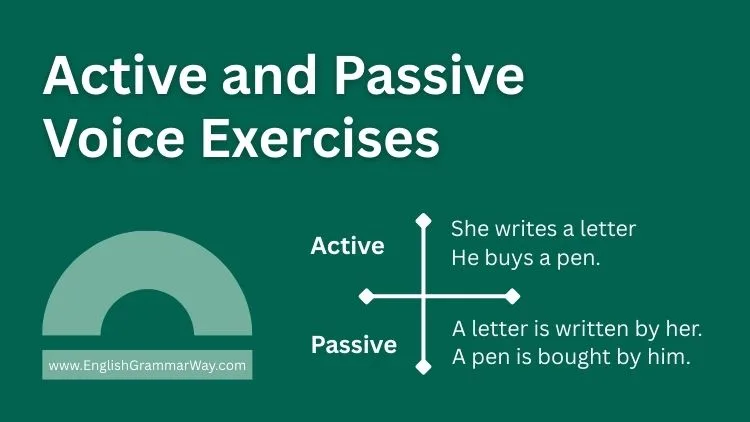
Active voice and passive voice describe how the subject and action are arranged in a sentence. In active voice, the subject performs the action directly. For example: “The teacher explains the lesson.” This structure is clear and easy to understand.
On the other hand, passive voice focuses on the action or the object rather than who performs it. For example: “The lesson is explained by the teacher.” Here, the subject receives the action instead of doing it.
Understanding this difference is essential when learning Passive Voice to Active Voice, because the goal is to make sentences clearer, shorter, and more engaging without changing their meaning.
🔗 Keep Reading: Active and Passive Voice Exercises
10 Simple Steps to Change Passive Voice to Active Voice
Converting passive voice to active voice improves clarity, readability, and engagement in writing. Active sentences are more direct, concise, and easier for readers to understand. These 10 steps guide students through identifying passive constructions, rearranging sentences, and practising effectively to master active voice.
Step 1: Identify the Subject, Verb, and Object
Before converting a sentence from passive to active, it’s important to know who performs the action, what the action is, and who receives it. Identifying these elements helps students avoid confusion and ensures the sentence is rewritten correctly. This step is the foundation for converting sentences accurately.
Example:
Passive: The book was read by Sarah.
Active: Sarah read the book.
Example Explanation:
In this sentence, “Sarah” is performing the action, “read” is the action, and “the book” receives it. Identifying these parts allows students to understand the sentence structure clearly, making it easier to rewrite in active voice correctly.
Step 2: Spot the Passive Construction
Passive sentences usually contain a form of “be” (is, was, were, has been) plus a past participle. Spotting this structure allows students to quickly recognize which sentences need to be converted. Identifying passive sentences is essential for accurate rewriting.
Example:
Passive: The report is written by the manager.
Active: The manager writes the report.
Example Explanation:
The phrase “is written” indicates the sentence is in passive voice. By spotting this pattern, students know the doer needs to move to the subject position, helping them convert the sentence into active voice accurately.
Step 3: Rearrange the Sentence to Active Voice
In active voice, the doer of the action comes first, followed by the verb and then the object. Rearranging the sentence improves clarity and makes it more direct. This step helps students produce sentences that are easier to read and understand.
Example:
Passive: The song was sung by the choir.
Active: The choir sang the song.
Example Explanation:
Here, “the choir” is the doer, moved to the subject position, while “the song” remains the object. This rearrangement shows students how the action flows naturally, making the sentence clear and engaging.
Step 4: Adjust the Verb Tense if Necessary
Sometimes, converting passive to active requires slight adjustments to the verb tense to maintain the original meaning. Ensuring the tense is correct helps students convey the same timeframe while placing the doer first.
Example:
Passive: The homework has been completed by the student.
Active: The student has completed the homework.
Example Explanation:
The verb “has been completed” in passive is changed to “has completed” in active, keeping the tense accurate. This shows students how to preserve the timing of actions while converting to active voice.
Step 5: Remove “by” Phrases Where Possible
In active voice, the doer is already the subject, so the “by” phrase is often unnecessary. Removing it makes sentences shorter, clearer, and more professional. Students learn to simplify sentences without changing meaning.
Example:
Passive: The room was cleaned by the janitor.
Active: The janitor cleaned the room.
Example Explanation:
Since “the janitor” is the subject, the “by” phrase is redundant. Removing it creates a shorter, more readable sentence. Students see how unnecessary words can be eliminated to improve clarity.
Step 6: Make Sure the Subject is Doing the Action
In active sentences, the subject must perform the action, not just receive it. This ensures the sentence communicates clearly who is responsible for the action.
Example:
Passive: The letter was mailed by John.
Active: John mailed the letter.
Example Explanation:
“John” performs the action of mailing, so he becomes the subject. This shows students how making the doer the subject clarifies responsibility and improves sentence accuracy.
Step 7: Keep the Meaning Same
Converting sentences should not change the original meaning. Active voice should convey the same information clearly while improving readability.
Example:
Passive: The decision was made by the committee.
Active: The committee made the decision.
Example Explanation:
The active version communicates the exact same idea. Students learn how to maintain accuracy while rewriting sentences in active voice, ensuring the message stays consistent.
Step 8: Check for Grammar Accuracy
After conversion, check that verb forms, articles, and word order are correct. Grammar accuracy ensures the sentence is professional, readable, and free of errors.
Example:
Passive: The meeting was attended by many employees.
Active: Many employees attended the meeting.
Example Explanation:
The active sentence maintains proper subject-verb agreement and correct word order. Students see how careful checking prevents grammar mistakes when changing voice.
Step 9: Read the Sentence Aloud
Reading aloud helps students hear mistakes, awkward phrasing, or tense errors. It ensures the sentence flows naturally and improves both writing and speaking skills.
Example:
Passive: The cake was baked by Anna.
Active: Anna baked the cake.
Example Explanation:
Saying the sentence aloud shows if it sounds natural and clear. Students can detect issues in flow, tense, or clarity, helping them internalize correct active sentence structure.
Step 10: Practice with Multiple Examples
Consistent practice with different sentences helps students quickly recognize passive constructions and rewrite them correctly. Practice builds confidence and speed in using active voice.
Example:
Passive: The car was repaired by the mechanic.
Active: The mechanic repaired the car.
Example Explanation:
Practicing with examples like this helps students identify passive sentences faster. Repeated exercises improve understanding, making active voice use natural and automatic in both writing and speaking.
🔗 For more tips, check our posts on: What is Voice in English? and Active and Passive Voice Exercises
How to Identify Passive Voice in a Sentence
Identifying passive voice is an important skill before converting it. A sentence is usually passive when the subject does not perform the action. Instead, the action happens to the subject. Another strong indicator is the use of auxiliary verbs like is, was, were, has been, followed by a past participle.
For example:
The book was written by the author.
Here, “the book” is not doing anything; it is receiving the action. Therefore, this is passive voice.
However, not all sentences with “was” are passive. You should always check whether the subject performs the action. Once you identify passive construction correctly, converting Passive Voice to Active Voice becomes much easier and more accurate.
Passive to Active Voice in Different Tenses
Changing passive to active depends on the tense of the sentence. In every tense, the subject must perform the action. Practicing with different tenses improves accuracy and helps you convert passive to active more quickly.
Present Simple Tense
Passive: The letter is written by her.
Active: She writes the letter.
Past Simple Tense
Passive: The match was won by the team.
Active: The team won the match.
Future Simple Tense
Passive: The work will be completed by him.
Active: He will complete the work.
Present Continuous Tense
Passive: The room is being cleaned by them.
Active: They are cleaning the room.
Present Perfect Tense
Passive: The task has been finished by her.
Active: She has finished the task.
These tense-based examples show how passive to active voice conversion keeps the meaning but improves clarity.
FAQs About Passive to Active Voice
Q1. What is the easiest way to change passive voice to active voice?
Identify the doer of the action and make it the subject. Adjust the verb accordingly and remove any “by” phrases if needed. For example, “The cake was baked by my mother” becomes “My mother baked the cake.” Start with simple sentences and practice regularly.
Q2. Can all passive sentences be changed into active voice?
Most passive sentences can be changed, but not all. If the doer is unknown or unimportant, passive is fine. For example, “The window was broken” doesn’t mention who did it. Use active voice for clarity, but passive works when the action matters more than the doer.
Q3. Is passive voice always wrong in English?
No, passive voice is grammatically correct and has its uses. It is helpful when the action is more important than the subject. For example, “The experiment was conducted successfully” emphasizes the experiment itself rather than who did it.
Q4. How do you identify passive voice in a sentence?
Passive voice occurs when the subject receives the action. Look for forms of “be” (is, was, were) plus a past participle and often a “by” phrase. Example: “The homework was completed by the student.” Recognizing these patterns helps convert passive to active voice correctly.
Q5. What are the benefits of using active voice over passive voice?
Active voice is clearer, direct, and easier to read. It highlights the subject performing the action, making sentences stronger. For example, “The teacher explained the lesson” sounds more natural than “The lesson was explained by the teacher.” Active voice improves clarity and engagement.